
How Nexr gave global mining professionals a firsthand encounter with Mine Safe's safety technology at MINExpo Las Vegas.
Mine Safe Global develops collision avoidance systems for high-risk mining environments. Their CAS technology, originating from South Africa, monitors vehicle proximity, adjusts speed in real time, enforces no-go zones, and intervenes dynamically to prevent accidents. On an open-pit mine, the difference between the system working and the system failing is the difference between a near-miss and a fatality.
In the field, the technology earns its reputation through performance. At MINExpo 2024 in Las Vegas, one of the largest mining industry exhibitions in the world, performance in the field counts for nothing if you cannot communicate it to a room full of engineers, procurement leads, and operations managers who have seen every kind of product demonstration before.
How do you demonstrate a safety system that only becomes visible when something almost goes wrong?
Mine Safe needed something that could convey technical depth to a global audience without a brochure, a slide deck, or a guided walkthrough. The experience had to register immediately, physically, and in a way that stayed with people after they left the booth.
Nexr identified three distinct obstacles, each of which compounded the difficulty of the others if any one was handled poorly.
Complexity that resists compression: The CAS performs several overlapping functions simultaneously: proximity detection, dynamic follow distances, no-go zone enforcement, crawl mode, real-time warnings. Simplify it too aggressively and it looks like a basic alarm system. Present all of it at once and the audience loses the thread.
A trade show floor punishes passive content: MINExpo draws thousands of attendees across an enormous exhibition floor. Stopping foot traffic is not a function of having the best product. It requires giving someone a reason to pause, turn, and commit their attention.
Abstract safety does not demonstrate well: A collision avoidance system works by preventing events that never occur. There is no accident to show. The demonstration had to take something invisible and make it felt, and it had to do so in under two minutes.
Beyond these three, Mine Safe carried an additional objective into the event: to show that South African-developed technology belongs on a world stage. This was not simply a product launch. It was a proof point for an entire industry's capacity to compete globally.
No explanation, however well crafted, replicates the physical sensation of sitting in the cab of a 100-tonne haul truck when the collision avoidance system engages. Ninety seconds inside a VR simulation does. That was the starting point for everything Nexr built.
Nexr developed a full VR driving simulation, built in Unity with mine environments modelled in Blender, that placed users in the driver's seat of a heavy vehicle navigating a realistic open-pit mine. Rather than presenting CAS features as a list, each function was embedded as a live scenario. Users encountered the system by triggering it, not by being told about it.
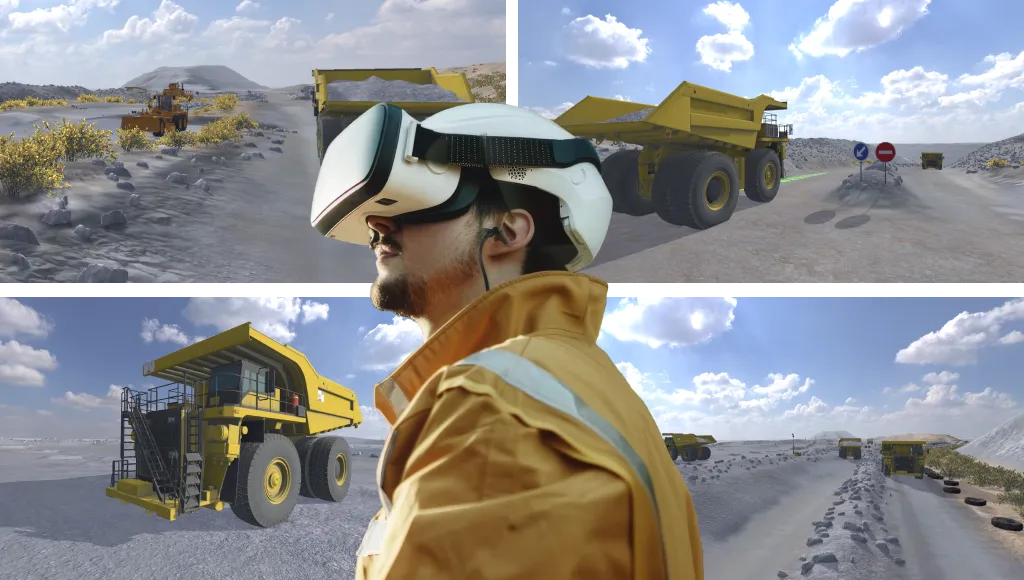
A VR headset alone would not have been sufficient. Nexr collaborated with EG Evolved to build a custom driving rig around the simulation: a steering wheel, pedals, and real-time force feedback that allowed users to physically feel the vehicle responding to the CAS as it engaged.
Why force feedback changed everything
The moment a user feels the vehicle slow under their hands rather than simply watching it happen on screen, the system stops being a product feature and becomes a direct experience. That shift is what produces genuine comprehension, and genuine recall.
A large external monitor broadcast the simulation live to the exhibition floor, making every active user visible to passersby. The booth became a spectacle in its own right, not just a stand to walk past.
Guided UI overlays within the simulation ensured that first-time users understood what they were experiencing at each stage, without requiring a staff member to narrate the entire session.
Throughout MINExpo 2024, the simulation drew consistent crowds. While most exhibitors competed for passive glances, Mine Safe's booth required active participation. Engineers and operations managers who assess safety systems professionally formed queues to experience the CAS directly.
“The VR simulator forms a foundation for Mine Safe to build immersive training and safety initiatives in the mine and other sectors, both in South Africa and globally.”
– Marius De Meyer, Operations Manager, Mine Safe Global
That last point carries particular weight. The simulator was not designed as a single-use exhibition asset. Its architecture supports expansion into full training programmes, giving Mine Safe the means to onboard operators, run safety drills, and develop sector-specific variants without rebuilding from the ground up.
Immersive technology is not a production format. It is a way of thinking about what genuine understanding requires. When a buyer needs to feel something in order to believe it, a screen-based presentation will not close that gap. Nexr works from that principle, not from a menu of deliverables.
The decision to build a fully immersive, physically interactive simulation came from asking a different question at the outset. Not "what does Mine Safe need for MINExpo?" but "what does Mine Safe need their audience to understand, and what is the only kind of experience that makes that understanding real?"
Immersive thinking before immersive production: The problem here was not a missing marketing asset. It was a comprehension problem: how do you make a complex, invisible system credible to a sceptical professional audience in 90 seconds? The answer was always going to require presence, not presentation. We designed for the comprehension gap, not the content gap.
The right partners for the physical layer: A VR simulation without convincing physical feedback would have been a partial solution. The force-feedback rig required hardware expertise that sits outside software development. Nexr brought in EG Evolved specifically because the quality of the physical experience was not something to compromise on.
Built to keep working: An immersive experience that delivers value once, at one event, is a missed opportunity. The simulation Nexr built for Mine Safe is an architecture, not an artefact. It can be extended into training deployments, adapted for different sectors, and scaled without starting again. That is the standard we hold ourselves to from the first conversation.
No pressure. Just a practical conversation about relevance and fit.
Start a conversation


.svg)


.svg)


