
A standalone VR experience built for Virtutec that puts mining industry prospects underground before the sales conversation begins.

Virtutec specialises in VR-based training and simulation for the mining sector. Their understanding of the underground environment is detailed and operationally grounded, and they have built a reputation for using immersive technology to train people who work in it. What was missing was a way to bring that world into a client meeting: something that could show a prospective investor or partner what Virtutec actually does rather than simply describing it.
Conversations and off-the-shelf video and proposal content formed the basis of their existing approach. It served a purpose, but it wasn't theirs. No Virtutec-branded experience existed that a potential client could step into and feel the weight of what the company offers.
The gap between understanding what VR can do and believing it can work for you is not closed by explanation. It's closed by experience.
Virtutec had seen firsthand how VR lands with people who've never experienced it. The reaction when a headset goes on for the first time is immediate and visceral, and it's difficult to manufacture any other way. They wanted a version of that moment they could own, built specifically around their world and their work.
The goal was clear but the execution was demanding: build an experience so immersive and self-contained that anyone, regardless of their familiarity with VR, could put on a headset and immediately understand what Virtutec does. Three constraints shaped every decision made.
Physical Accuracy: Virtutec works in an industry where credibility is everything. The underground environment had to look and sound realistic: the machinery, the rock formations, the audio of working underground. Any detail that felt wrong would undermine the client's authority in front of their own prospects.
Standalone Deployment: The experience needed to run without a trained operator present. No one from Virtutec's team would be standing next to the headset explaining what to do. The entire experience had to guide a first-time VR user through a scripted sequence without any external input or UI interaction.
Hardware Constraints: High-fidelity assets are expensive to render, and standalone Meta hardware has a strict performance ceiling. Achieving high-fidelity visuals without dropping to unacceptable frame rates meant optimisation had to be built into the asset creation process from the start, not resolved at the end.
Delivering all of this on a tight timeline meant asset creation, environment build, logic development, and audio integration all had to run in parallel. The planning done upfront was what made that possible.
Rather than building a product showcase, Nexr set out to manufacture a feeling. Specifically: the physical shock of being underground when something goes wrong, followed by the immediate relief of being shown the technology that prevents it. Because Nexr's lead on the project had direct experience working underground, the creative direction came from the inside rather than from research.
The experience unfolds in two acts. The first is the rockfall sequence. The second is the showroom.
Placed underground alone, the user finds themselves in a high-fidelity mine environment with no instruction given. Large machinery is visible nearby. The audio of the underground environment is precise and immersive, with sound design playing an equally important role to the visuals. Time is given to look around and settle into the space before anything happens.
A small pebble then drops from the ceiling accompanied by a dust particle effect, a visual cue intended to prompt the user to look up. A larger rock follows if they don't. When they do look up, a boulder falls directly toward them, accompanied by a deafening, realistic sound that triggers an immediate physical fright response.
No controller input drives the sequence. No external prompting is needed. It is entirely gaze-triggered. The environment does the work.
No operator. No instructions. No exceptions.
Removing all UI interaction and external controls was not a simplification. It was the core design principle. Virtutec's team can hand someone a headset in a meeting room and the experience handles everything from there. When the headset comes off and goes back on, it resets automatically and starts from scratch.
The rockfall gives way to a branded showroom where users can pick up 3D models of Virtutec's equipment. Contextual video content plays around each model via overlays. Audio cues guide users through the space without any written instruction or external coaching required.
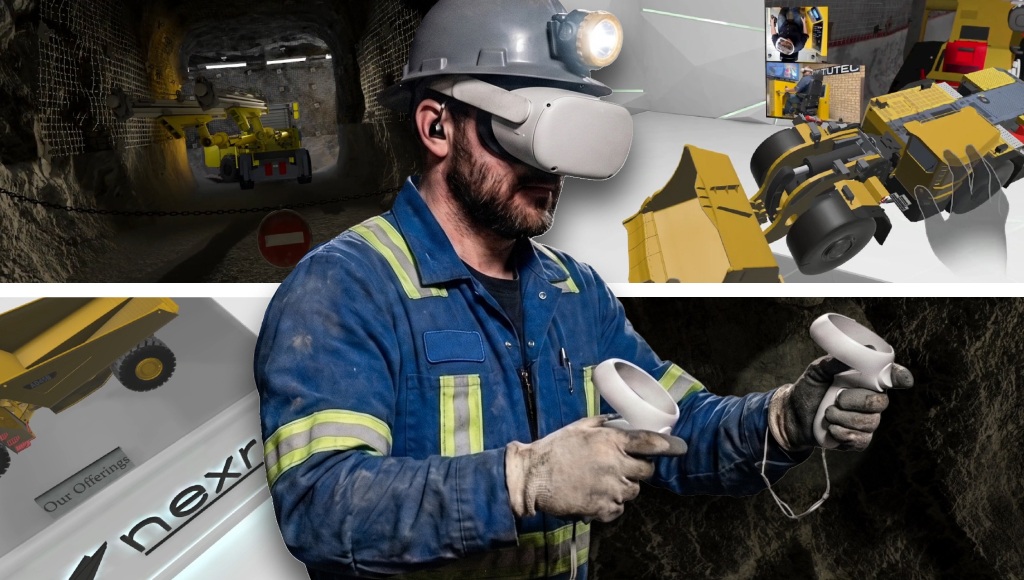
Demonstrated to prospective clients and investors, the experience has produced a consistent response. The rockfall sequence delivers the physical fright reaction it was designed to produce. Without exception, every first-time user has reacted. That reaction is not a side effect. It is the product, and it is what makes Virtutec's pitch land in a way that neither a conversation nor a slide deck can match.
Virtutec came to Nexr with a clear commercial need: prospects had to feel what they do, not just hear about it. Nexr's role was to take that need and build something technically precise enough to be credible and simple enough to be handed to anyone.
The decision to remove all operator dependency wasn't a production shortcut. It was a deliberate design choice that made the experience genuinely useful in the field. A VR tool that requires a trained person to operate it is a tool with friction. One that runs itself is a tool that scales.
Design to the Problem: The brief was a VR experience. The actual problem was that Virtutec had no way to let a prospect feel their expertise before a commercial conversation began. Nexr designed to that problem, not the deliverable.
Design for the Context: The experience had to work in a boardroom, handed to someone who had likely never used VR, with no support staff present. Every UX decision was made with that specific deployment context in mind: gaze triggers, audio cues, automatic reset.
Build What Lasts: This is step one of a planned VR hub. The decisions made here on interaction model, environment fidelity, and hardware platform will carry through into everything built on top of it. That foundation was built deliberately, not incidentally.
No pressure. Just a practical conversation about relevance and fit.
Start a conversation

.svg)


.svg)


