
How Nexr built a fully immersive, secure virtual boardroom that gave one of South Africa's leading financial institutions a working proof of concept for the future of professional collaboration.
THE SITUATION
Our client is one of South Africa's leading financial institutions. Over many years, Nexr has built a working relationship with them grounded in a shared commitment to solving real business problems through emerging technology, and to staying ahead of where their respective sectors are heading.
The pressure they were responding to was not a short-term operational problem. It was a longer-term talent and positioning question. As digitally native employees enter and advance through the workforce, their expectations of workplace technology are fundamentally different from those of previous generations. Standard video conferencing platforms were not designed with that audience in mind, and the gap between what those tools offer and what modern employees expect is widening.
What would a collaboration environment look like if it were designed for the way digitally native professionals actually want to work, rather than adapted from tools built for a previous era?
The client wanted to explore that question practically, not theoretically. They needed a proof of concept that could demonstrate the viability of immersive virtual collaboration at a professional standard, within a secure environment that met the demands of a regulated financial institution.
Delivering a VR boardroom for a financial institution is a different brief from delivering one for a general corporate environment. Each requirement raised the bar on the others.
Enterprise security could not be a constraint on the experience: Financial institutions operate under strict requirements for data protection and communication security. Any collaboration tool, however innovative, that introduced meaningful security risk would not be deployable. The VR environment needed to meet enterprise-grade security standards, including AWS infrastructure integration and isolated spaces for confidential discussions, without those requirements visibly constraining what the experience felt like to use.
The environment had to feel worth inhabiting: A VR meeting room that looks and functions like a digital replica of a Zoom call would not make the case for immersive technology. The client needed a space that felt genuinely different from screen-based alternatives: visually compelling, spatially coherent, and designed around how people actually behave in collaborative settings rather than how videoconferencing software structures them.
First-time users had to be productive immediately: The proof of concept would be evaluated by senior stakeholders, not VR enthusiasts. The interface needed to support presentations, whiteboarding, and session management in a way that was immediately navigable, with no tolerance for a steep learning curve undermining the case being made.
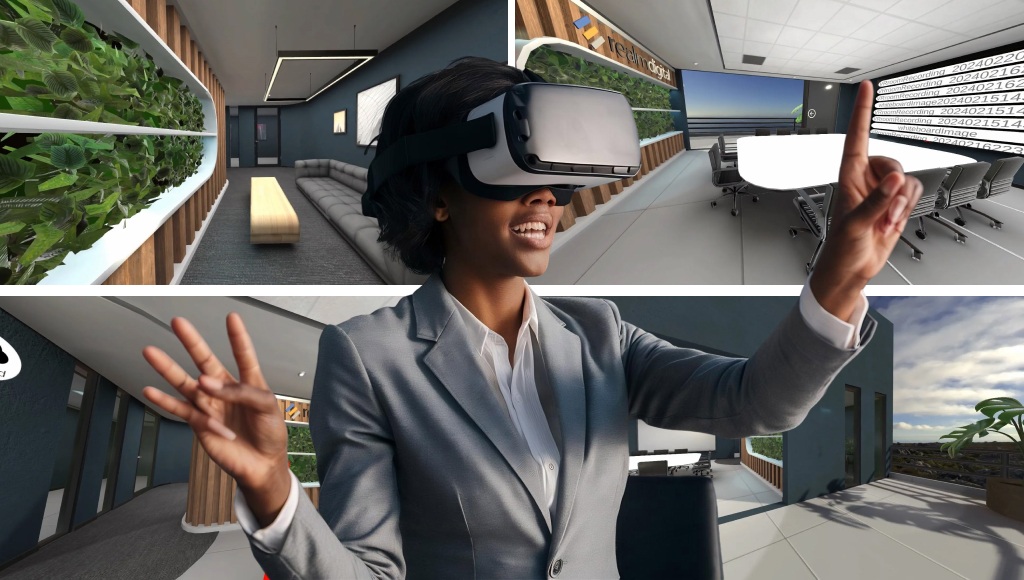
The starting point was fidelity to a physical space the client already had. Nexr modelled the VR boardroom directly on one of the client's recently acquired office spaces, giving the environment an immediate sense of authenticity and ownership. The virtual space included a welcoming area, a fully functional boardroom, and an adjoining patio with views across Cape Town.
Nexr delivered the full build across consulting, 3D modelling, texturing, level and asset design, and front-end and back-end development. All interactions and documents were synchronised with the client's AWS infrastructure throughout.
Every element of the back-end was built around the client's existing AWS infrastructure. The administrative portal gives authorised users direct access to AWS-stored files through a clean, functional interface. Security was not retrofitted to the experience. It was designed into the architecture from the start.
The patio is a detail that reveals the thinking behind the whole build. A virtual space with a dedicated area for confidential conversations, separated from the main room, is not a feature you add because it is technically interesting. It is there because real boardroom dynamics require it, and a collaboration environment that ignores that is not a serious alternative to the physical one.
The backdrop of Table Mountain visible from the virtual patio was a deliberate choice. It grounded the environment in a specific, recognisable place and gave the experience a quality of presence that generic virtual environments do not achieve. For a client making the case internally for immersive technology, that sense of place mattered.
The VR boardroom exceeded the client's expectations as a proof of concept. It demonstrated that immersive virtual collaboration can operate at a professional standard, with the security, usability, and environmental quality required in a regulated financial services context.
The value of a proof of concept is not only in what it demonstrates at the time. It is in what it makes possible next. This project gave the client a concrete foundation from which to evaluate broader deployment, whether across additional office environments, specific use cases, or expanded user groups.
There is a version of this project that would have been easier to build and less useful to the client: a visually impressive VR environment with the security and integration work deferred, or a technically robust back-end wrapped in a generic virtual space with no sense of place or ownership. Either approach would have answered a narrower brief. Neither would have made the case that needed to be made.
Nexr built this as a complete system because the client's actual question was not "can VR look good?" It was "can VR work here, in our context, for our people, at our standard?" Answering that required every layer of the build to be production-ready, not prototype-quality.
Proof of concept does not mean proof of possibility: A proof of concept that leaves the security architecture, the integration, or the user experience unresolved is not a proof of concept. It is a demo. Nexr built something the client could actually use, because that is the only way to learn what needs to change.
Fidelity to the real environment is a design decision: Modelling the VR space on the client's own office was not a cosmetic choice. It gave stakeholders a direct frame of reference for evaluating the experience, and it made the case for immersive technology on the client's own terms rather than on abstract ones.
Long-term relationships produce better briefs: This project came from years of working with a client who trusted Nexr to propose solutions they had not asked for. The VR boardroom concept came out of that relationship. The best immersive technology work rarely starts with a fully formed brief. It starts with a genuine understanding of where a client is trying to go.
No pressure. Just a practical conversation about relevance and fit.
Start a conversation


.svg)


.svg)


