
How Nexr built an immersive VR training simulation that lets PetroENG teams practise critical working-at-heights procedures in a controlled, repeatable environment before setting foot on a live site.
THE SITUATION
PetroENG is a Cape Town-based petroleum engineering and maintenance specialist operating across South Africa's petrochemical sector. Their work centres on bulk fuel depots, covering fuel infrastructure, compliance-driven upgrades, and HSEQ-led operational requirements in high-stress industrial environments where the margin for error is low and the consequences of procedural failure are serious.
Working at height on scaffolding is a routine part of PetroENG's operational reality. That makes hazard recognition, procedural adherence, and genuine physical confidence not optional extras in their training programme, but core requirements that have to be met before individuals are placed in live site conditions.
How do you build real procedural confidence in workers before they face the consequences of getting it wrong at height on an active site?
PetroENG came to Nexr as part of a broader innovation roadmap, looking at how VR could strengthen safety readiness across their operations. Early discussions identified working at heights as the highest-value first application. The goal was not to replace existing compliance training but to add a practical, immersive layer that could prepare workers more thoroughly before live assessment. PwC research supports the case for that approach: VR learners have been reported to be up to 275% more confident applying what they have learned compared to classroom-only training.
Building a VR training simulation for safety-critical industrial work is not the same as building one for a trade show or a corporate environment. The stakes attached to the realism of the experience are direct and measurable.
Translating physical scaffolding work into a credible virtual environment: Working at height has a physical and psychological reality that is difficult to replicate. The simulation needed to capture the movement constraints, decision points, and emotional weight of being on scaffolding at height. Without that credibility, the training value would be superficial. Achieving it required Nexr's team to complete working-at-heights training on site and spend time on the scaffolding itself before design began.
Designing for first-time VR users in a training context: The simulation would be used by workers in safety training, not by people with prior VR experience. Every interaction had to be immediately intuitive. Hand tracking was explored and set aside after structured walkthroughs showed that controllers provided a more consistent and accessible input method, with less friction for first-time users and more reliable performance across training sessions.
Delivering within PetroENG's on-site safety standards: The project was developed in an active industrial environment with strict safety protocols governing access and conduct. The solution had to be designed in full compliance with those standards from the start, not adapted to meet them after the fact.
VR gives teams a realistic, repeatable way to practise the right decisions, without the consequences of getting it wrong on a live site."
– HSEQ spokesperson, PetroENG
The decision that distinguished this project from a conventional software build was made before any development began. Nexr's team completed working-at-heights training on site and spent time on the scaffolding at PetroENG's facility. That direct experience informed everything: the movement system, the environmental detail, the pacing of the scenarios, and the specific decision points built into the simulation.
The final experience was built around a movement system that allowed users to climb and interact with scaffolding through physical actions rather than abstract navigation. That design choice was central to the realism the simulation needed to achieve, and to the confidence it needed to build.
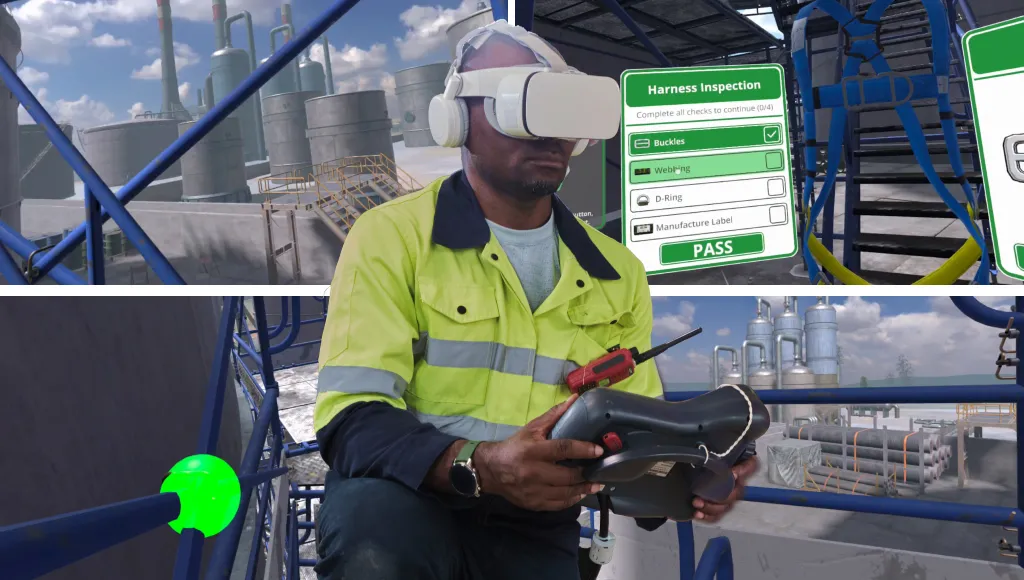
Hand tracking was tested and set aside. Controllers provided a more consistent input method for workers encountering VR for the first time, and consistency in a training context matters more than technical sophistication. Adoption depends on the experience working reliably for every user, not just the ones who pick it up quickly.
The fall sequence is the moment the simulation earns its place in the training programme. When a user experiences the consequence of an incorrectly fitted harness inside a controlled environment, the procedural requirement stops being a compliance checkbox and becomes something they have felt. That is what changes behaviour.
The simulation was designed from the outset as a foundation, not a finished product. The scalable architecture supports future expansion into additional safety-critical modules, including confined space preparation and further scaffolding assessment, without requiring a rebuild. Integration with PetroENG's Learning Management System, to support certification tracking and compliance oversight, is planned as the programme develops.
Following delivery, structured walkthroughs with PetroENG's scaffolding and safety personnel confirmed that the simulation captured both the physical sensation of climbing and the emotional impact of working at height, including the fall sequence. That confirmation mattered: it established the simulation as a credible preparation step before live site assessment, not just a technical demonstration.
"A lot of incidents don't start with equipment failure - they start with human behaviour under pressure. We wanted to make sure our people are more readily prepared to prevent unsafe behaviour before it turns into an incident."
– HSEQ spokesperson, PetroENG
The programme also signals PetroENG's broader commitment to digital innovation within safety-critical operations, and positions them to build out a more comprehensive immersive training capability as their roadmap develops.
Immersive training only works if the experience it creates is credible to people who do the real thing for a living. Scaffolding workers know what it feels like to climb. Safety officers know what a correctly rigged harness looks like. If either group finds the simulation unconvincing, the training value disappears. That is why Nexr's team completed the training and got on the scaffolding before a single design decision was made.
The question that shaped the project was not "how do we build a VR training module?" It was "what does a worker on this scaffolding actually experience, and what needs to be true for a simulation to prepare them for it?" Everything followed from that.
Realism is earned through research, not rendered in post: The fidelity of this simulation came from direct site experience, not from photorealistic graphics. The movement system, the decision points, the consequence sequences - all of it was grounded in what Nexr's team encountered on the scaffolding itself. That is the work that makes immersive training credible rather than impressive.
Usability is a safety consideration, not a design preference: In a training context, an experience that some users find difficult to navigate is an experience that delivers inconsistent outcomes. The decision to use controllers over hand tracking was made because consistent, reliable adoption across all users was more important than technical novelty. In safety-critical training, that is not a compromise. It is the correct call.
Modular foundations are how training platforms scale: A simulation built to address one procedure, with no path to expansion, is a closed investment. Nexr built PetroENG a platform architecture that can grow with their safety programme, adding modules, integrating with their LMS, and extending into new risk areas without starting again. The value compounds over time rather than ending at deployment.
No pressure. Just a practical conversation about relevance and fit.
Start a conversation


.svg)


.svg)


