
How Nexr built a modular, first-person VR training tool that moves unconscious bias training from intellectual understanding to lived experience.
THE SITUATION
Ikigai People Advisory Services is a consultancy that helps organisations build more conscious, connected, and equitable workplaces. Their work spans leadership coaching, inclusive organisational design, and human capital advisory, drawing on behavioural science to drive practical change in how companies operate and how people within them relate to one another.
Ikigai had built a strong unconscious bias training programme. The challenge was not the content. It was the format. Workshops, presentations, and structured discussions can explain bias clearly and accurately. What they struggle to do is make participants feel the weight of it from the inside.
How do you move someone from understanding bias intellectually to recognising it viscerally, in the moment, as the person on the receiving end?
Ikigai wanted a learning tool built around perspective, not instruction. The goal was to place users inside the experience of someone affected by bias, and to do it with enough emotional precision that genuine empathy and reflection followed naturally.
The brief asked for something that had to work on three levels simultaneously, and weakness in any one of them would have undermined the others.
Making bias feel real without feeling manufactured: Workplace bias is subtle, cumulative, and often ambiguous. Scenarios that felt scripted or exaggerated would break the emotional credibility the training depended on. The three initial scenarios, covering mansplaining, disability bias, and exclusion through biased job criteria, each needed to carry genuine emotional weight while remaining grounded in everyday working life.
Building for expansion from day one: Ikigai works across multiple clients and sectors. A bespoke tool that required significant rework for each new scenario or client context would not be commercially viable. The architecture needed to support rapid content development without sacrificing quality or consistency.
Immersion that works for people who have never used VR: The training was designed for corporate participants, not technology enthusiasts. The experience had to be immediately navigable for first-time headset users, without lengthy onboarding interrupting the emotional arc of the scenarios themselves.
The decision that shaped the entire build was to place users not as observers of bias but as the person experiencing it. Every technical and design choice followed from that commitment to genuine first-person immersion.
Nexr built the platform in Unity, with supporting work in Blender and Photoshop, delivering a fully immersive VR training tool that weaves narrative, interaction, and structured reflection into a single continuous experience.
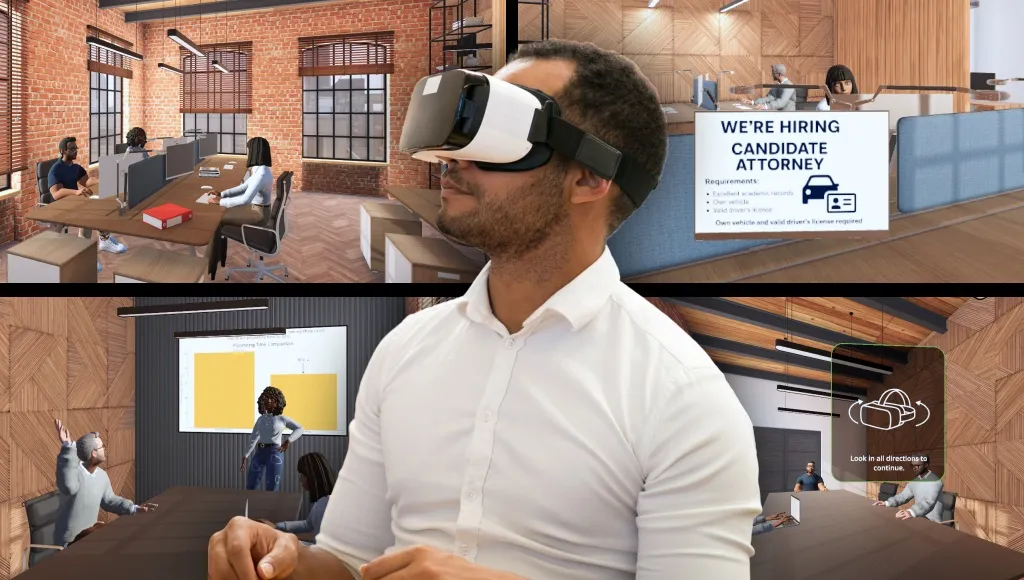
The AI-driven content system was a deliberate architectural choice, not a production shortcut. By removing the dependency on manual voiceover recording and traditional animation pipelines, Nexr gave Ikigai the ability to respond to specific client briefs and HR challenges with new scenarios at a pace that a conventional build process would not have supported.
Placing users in the body of someone experiencing bias, rather than asking them to observe it from the outside, is what separates this from any screen-based equivalent.
The modular framework Nexr built gives Ikigai a commercially flexible product. New scenarios can be developed rapidly for different clients, sectors, and training contexts, making the platform a scalable extension of Ikigai's consulting offering rather than a fixed asset tied to a single programme.
The completed platform gave Ikigai a fundamentally different way to deliver unconscious bias training. Participants move through scenarios as a lived experience rather than a theoretical exercise, and the structured reflection tools built into each module ensure the emotional impact translates into retained learning.
"Partnering with Realm took our unconscious bias work from something people talk about to something they can truly feel. Together, we created an immersive experience that makes the unseen seen - sparking empathy, reflection, and real behaviour change. It's a powerful way to connect with people on a deeply human level and to bring our work to life across clients and industries."
– Taya Buchanan, Alchemist at Ikigai People Advisory Services
The platform is not a finished product in a fixed state. Its architecture was designed to grow with Ikigai's practice. As new clients bring new contexts, the tool expands with them, building out a library of scenarios that compounds in value over time.
Immersive technology can show an audience many things. What it does uniquely well is place someone inside a perspective they would not otherwise occupy. That capability is only valuable if the experience is designed around it from the start, not added as a feature after the content is already written.
For Ikigai, the question Nexr asked early was not "how do we make this training more engaging?" It was "what would it take for a participant to leave this experience having genuinely felt something they had not felt before?" The answer determined everything: the first-person perspective, the haptic feedback, the real-time avatar expressions, the post-scenario reflection structure.
Emotional precision is a technical discipline: Creating scenarios that carry real emotional weight without tipping into artificiality requires as much technical craft as narrative judgment. The animation system, the AI-driven dialogue, and the sensory feedback layers were all built in service of a single goal: credibility. If a participant senses the artifice, the empathy collapses.
Modular architecture is a strategic asset: A training tool that requires significant rebuild for every new client is not a product. It is a series of bespoke commissions. Nexr built Ikigai a system, not just a set of scenarios. The AI content pipeline and flexible animation framework mean the platform grows in utility with every deployment rather than requiring reinvestment each time.
Immersive technology belongs in learning: The application here is diversity and inclusion training, but the underlying capability is not sector-specific. Any learning context where the gap between knowing and feeling is the barrier to behaviour change is a context where immersive technology can do work that no other format can.
No pressure. Just a practical conversation about relevance and fit.
Start a conversation


.svg)


.svg)


